
NEW YORK — Kyle Tucker has been searching all season long.
It has been a trying first year in Los Angeles for the Dodgers’ marquee off-season signing. Tucker came into Friday’s series opener against the New York Mets with a .689 OPS, nearly 200 points lower than his career mark. His strikeout rate is nearly 20 percent, which would be his highest over a full season. Tucker’s power had been zapped — of his 82 hits, 55 were singles and just seven were homers. Tucker has never hit fewer than 22 homers in a full season.
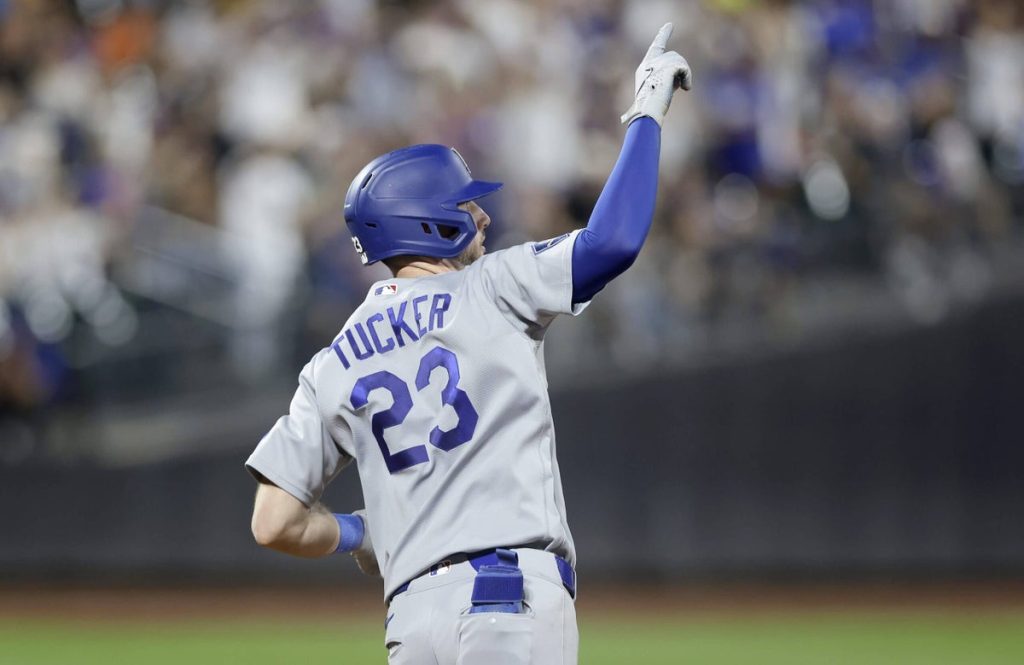
When Mets’ reliever A.J. Minter left a 94-mph fastball center-cut, Tucker did what he was supposed to do — something he has done too rarely in a Dodger uniform. Tucker turned on the pitch and barreled it to right field for a two-run shot, providing the Dodgers with pivotal insurance runs in a 4-2 victory.
It was Tucker’s first home run in over a month. It was also a reminder of the production the Dodgers want to see from their corner outfielders throughout the final two months of the regular season.
“Felt good overall,” Tucker shrugged. “Just trying to have good at-bats and do more of that.”
Obviously, that’s much easier said than done.
When the Dodgers signed Tucker to a four-year, $240 million contract this winter, they did so believing he would slot in near the top of an already packed lineup. The team was still weeks away from spring training when manager Dave Roberts dubbed Tucker either his No. 2 or No. 3 hitter, spots usually reserved for a club’s most prolific hitters.
But Tucker’s lack of production resulted in a drop to the bottom third of the order. It hasn’t helped that his corner counterpart, Teoscar Hernández, has also slumped since returning from a hamstring injury. With the Dodgers at an MLB-best 66-38, there isn’t much to nitpick about this roster. Still, the club wants more slug and more power from its corners.
“It’s important,” Roberts said after the game. “When we put this team together, you don’t see Tucker in the (seventh spot), Teo in the 8. But once they get going, it adds some true length to our lineup. The corner production in the outfield hasn’t been what it needs to be, but I do believe that the back of the baseball card means something.”
Big swing, Kyle! pic.twitter.com/cvBkaREqJ6
— Los Angeles Dodgers (@Dodgers) July 25, 2026
Friday was a promising sign. Tucker, who last homered on June 21 against the Orioles, finished 2-for-3 with a walk. Hernández also had two hits, including a leadoff double in the third, with a run scored. The Dodgers banged out 11 hits, though they went 1-for-13 with runners in scoring position. Still, they provided enough run support to back up a stellar outing from Roki Sasaki, who twirled seven innings of one-run ball and struck out nine.
But in the eyes of both veterans, one good game doesn’t erase a month of struggles.
“There are some times where I like to see the ball coming in, put a swing on it, and I can visualize the ball coming off the bat and doing what I want with it,” Tucker said, “but it doesn’t really go that way — which is a little frustrating.”
“One or two games good, then five bad,” Hernández added. “But the last three, four games, it’s getting there. I’m missing a lot of pitches I shouldn’t miss. I think that’s part of it.”
Most of the frustration from Hernández stems from how well he was playing before suffering a Grade 1 hamstring injury in late May. After a slow start to the season, Hernández caught fire in May, posting a .325 average and an .882 OPS before spending the next four weeks on the injured list. Since being reinstated, his offensive production has been virtually non-existent. Coming into Friday’s game, Hernández was hitting .136/.212/.203 through his past 17 games.
“I was really good before (the hamstring injury),” Hernández said. “The timing was there. I was hitting the ball all over the place, extra bases. But it’s tough to miss a month. It’s going in the right direction. When I’m swinging at good pitches to hit, putting the ball in play with hard contact, that’s good progress.”
Tucker, too, tries to stay positive. He’s dropped his strikeout rate from 28 percent in June to 11 percent in July, which is more indicative of his career plate discipline. Still, after four consecutive All-Star seasons and a contract that includes a record-setting $60 million annual average value, he knows his numbers have not nearly been enough.
“It’s a long season,” he said. “It can be tough at times. But you just have to do your best at that and just keep going out there and keep aligned with everything offensively and just do your best. Trying my best at that.
“Everyone here is supportive, from the players to the coaching staff, everyone. At some point, you have to be confident in yourself.”
The good news is that the Dodgers’ cozy 11-game division lead allows for patience with both sluggers. And the organization still feels there’s plenty of time for Tucker and Hernández to get right for October. While the Dodgers acknowledge the production hasn’t been what they hoped, they believe Tucker will be the impact bat they envisioned when they signed him.
“It’s coming,” Roberts said. “It hasn’t been as consistent or as fast as we’d like, but he’s still going through it. He’s still working hard, and to see some success tonight was a good thing for him. It’s been a constant battle. … He competes every at-bat, and hopefully some results are on the way. But tonight was a big step in the right direction.”
The Dodgers should have another option returning soon. Kiké Hernández (oblique strain) is on a rehab assignment with Triple-A Oklahoma City, and could be back with the Dodgers as early as Tuesday. That won’t impact Tucker’s playing time, but Kiké Hernández could see reps at second base, which would allow Tommy Edman to play left field, creating a semi-platoon with Teoscar Hernández.
That should help improve the offense from the corner outfield positions. But as the Dodgers coast toward the dog days of the season, they need Tucker and Teoscar Hernández to be better.
“Both guys are working hard,” Roberts said. “We need those guys to be good.”