
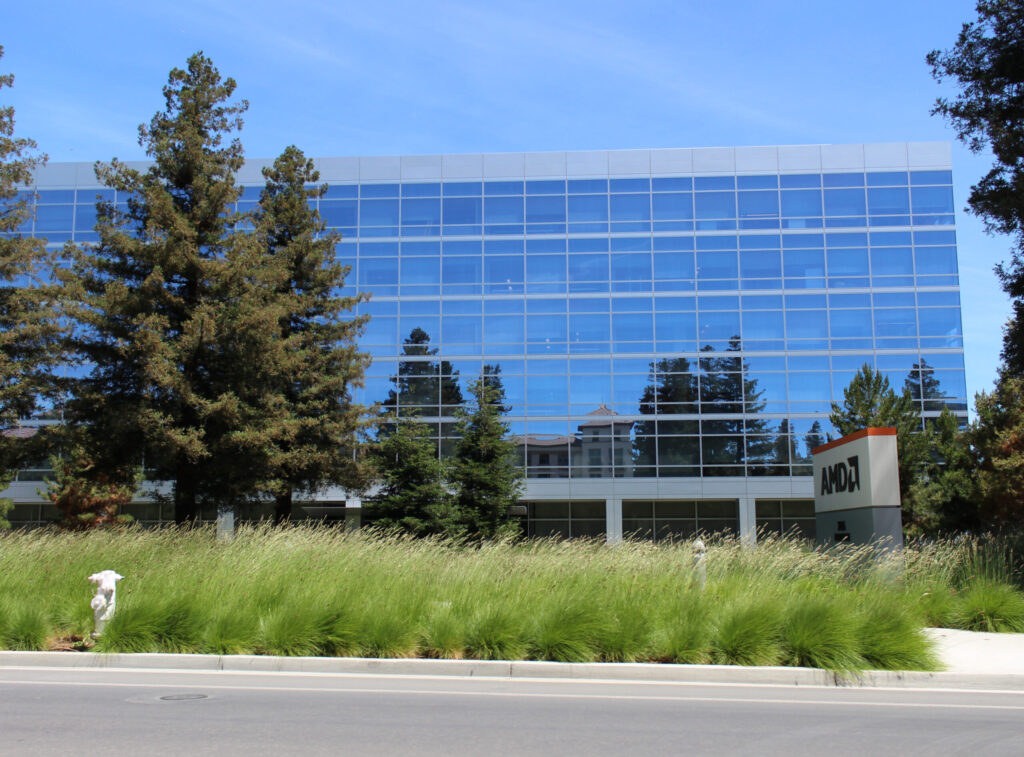
AMD Faces Investor Investigations Over China Firmware Allegations
Advanced Micro Devices (NASDAQ: AMD) is facing shareholder-law-firm investigations after a short-seller report alleged that updated AMD server firmware continued reaching a Chinese manufacturer subject to US export restrictions, raising questions about the chipmaker’s compliance procedures and its exposure to China.
Hunterbrook Media published the allegations on November 19, 2026, claiming that IEIT Systems incorporated newer AMD firmware into server software after the US Commerce Department added the company to its Entity List in March 2025.
AMD rejected the allegations, stating that the report misrepresented its business relationships and that the company complies with applicable US export-control requirements.
The controversy sent AMD shares down 7.72% on November 19 to $489.19, a decline of $40.95 from the previous session. Shares extended their losses on November 20 as several law firms announced investigations into potential securities law violations.
What Does the Short-Seller Report Allege?
Hunterbrook claims that IEIT Systems incorporated at least six newer versions of AMD’s startup firmware into server updates following its March 2025 blacklisting. The latest identified update was posted on October 19, 2026.
The software reportedly contained AMD’s TurinPI 1.0.0.B firmware, which supports the operation of AMD processors in server systems.
The report also identified three companies allegedly connected to IEIT: Maginfra in China, Kaytus in Singapore and Aivres in California. Hunterbrook said firmware files distributed by those companies closely matched software used in IEIT servers.
The investigation cited corporate records indicating ownership relationships involving Kaytus and Aivres, raising questions about whether firmware could have reached the blacklisted manufacturer through intermediaries.
Hunterbrook Capital, an investment fund affiliated with the publication, disclosed a short position in AMD, giving it a financial interest in a decline in the company’s share price.
Importantly, the report does not establish that AMD directly supplied restricted software to IEIT, that any transfer occurred without authorization or that AMD violated US export regulations.
As FinanceFeeds reported following the initial allegations, the presence of matching firmware does not establish who supplied it or whether the relevant transaction required an export licence.
How Has AMD Responded to the Allegations?
AMD rejected Hunterbrook’s characterization of its operations, stating: “The claims misrepresent AMD’s business practices and relationships.”
The company also said it maintains rigorous compliance processes across its international operations.
The US Commerce Department’s Bureau of Industry and Security added IEIT Systems to its Entity List effective March 25, 2025, requiring licences for exports, reexports and transfers of items subject to US export regulations.
Those requirements can apply to software as well as physical hardware. However, determining whether a violation occurred requires evidence about the supplier, the technology transferred, its regulatory classification and any applicable authorizations.
No formal Commerce Department enforcement finding against AMD concerning the reported IEIT firmware transfers has been identified.
The distinction between software appearing in a restricted company’s products and an unlawful export by AMD remains central to assessing the allegations.
Investor Takeaway
The immediate regulatory question concerns the origin and authorization of the firmware, not simply its presence in IEIT products. Without evidence of an unauthorized transfer attributable to AMD, the report establishes a potential compliance concern rather than a confirmed export-control violation.
How Much Revenue Does AMD Generate From China?
AMD’s geographic revenue disclosures demonstrate why changes to US export restrictions could have meaningful financial consequences.
The company’s fiscal 2025 annual report attributed approximately $7.75 billion in revenue to customers billed in China and Hong Kong, representing 22.4% of total annual revenue of $34.64 billion.
Another $4.28 billion was attributed to customers billed in Singapore, equivalent to approximately 12.4% of annual revenue.
These figures reflect customer billing locations, not necessarily the ultimate destination of processors or the amount of revenue derived from restricted products. They should not be interpreted as evidence of prohibited shipments.
AMD has already experienced financial consequences from separate export restrictions. Licensing requirements affecting its Instinct MI308 accelerators resulted in approximately $440 million of net inventory and related charges during fiscal 2025.
The company nevertheless reported strong third-quarter 2026 performance, with revenue reaching $13.38 billion, up 45% year over year. Data Center revenue increased approximately 97% to $8.5 billion, as detailed in FinanceFeeds’ coverage of AMD’s quarterly results.
AMD expects fourth-quarter revenue of approximately $17 billion, plus or minus 3%, supported by demand for EPYC processors and Instinct AI accelerators.
The company faces additional export requirements as Washington extends licensing controls to advanced computing products shipped through certain third-country markets, including Singapore, Malaysia, Thailand, Indonesia and Brazil.
Similar restrictions have already complicated Nvidia’s ability to supply advanced processors to Chinese customers.
Investor Takeaway
AMD’s growth increasingly depends on data center processors and AI accelerators, where export requirements can affect market access. The company’s geographic revenue exposure is financially significant, but the amounts billed to China and Singapore cannot be equated with potentially restricted sales.
What Are the Risks From Shareholder Investigations?
Several US law firms, including Kaplan Fox & Kilsheimer, Kirby McInerney, Portnoy Law Firm and Schall, Brown & Schwartz, announced investigations following Hunterbrook’s report.
The firms are examining potential securities law claims involving AMD’s disclosures and business practices. These announcements represent preliminary investigations, not findings of securities fraud or judgments against the company.
Any subsequent litigation would need to establish the relevant legal elements, including whether investors received materially misleading disclosures and whether those disclosures caused compensable losses.
For shareholders, the most consequential developments would be a formal regulatory action, evidence establishing unauthorized technology transfers or new disclosures indicating that export restrictions could affect revenue or margins.
Neither the short-seller allegations nor the law-firm announcements currently provides a reliable basis for estimating potential penalties or litigation liabilities.
Investor Takeaway
The legal investigations add uncertainty but do not establish wrongdoing. AMD’s financial exposure will depend on whether regulators identify an actual compliance failure, whether customer relationships face additional restrictions and whether any resulting costs materially affect the company’s earnings outlook.